Europe’s future at stake: snapshots from Financial Investigator's seminar
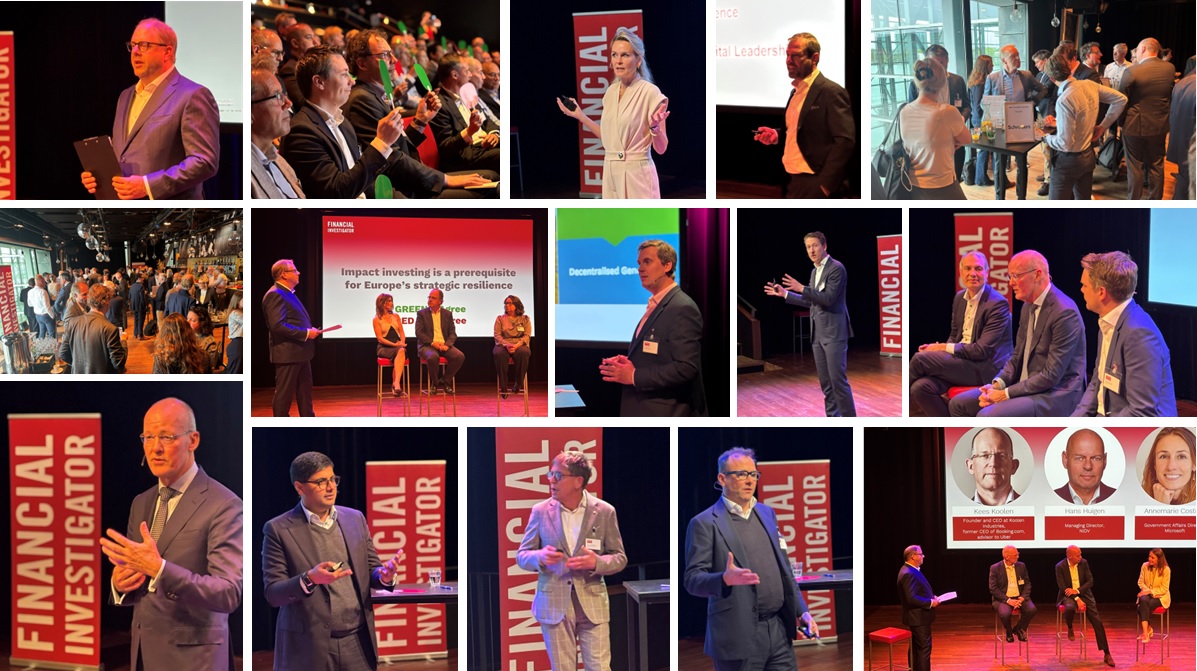
At a packed BIMhuis in Amsterdam, institutional investors gathered for the Financial Investigator seminar ‘Europe’s Future at Stake: Investing in Energy Security, Defence & Digital Leadership’, where a recurring theme emerged throughout the day: Europe is entering a period of structural change that demands a fundamental rethink of investment strategies.
Opening the seminar, Arjen Pasma, CIO at PGGM, set the tone by raising questions around strategic autonomy, geopolitical risk and the allocation of capital in an increasingly fragmented world.
The opening speech was delivered by Barbara Baarsma, Chief Economist at PwC Netherlands. She described the current environment as one of “structural instability”, in which multiple forces interact and amplify one another.
“Geopolitics, climate stress, technological disruption and social fragmentation no longer act separately. They reinforce each other,” she noted.
According to Baarsma, resilience can no longer be an afterthought: “Resilience has to be designed in — balancing efficiency with buffers, diversity, learning capacity and collective action.”
From policy ambition to investable reality
A central question throughout the seminar was how Europe can translate policy ambition into investable opportunities. Bouke Evers, Partner at EY, argued that the transition narrative needs to shift: “We need a new narrative, defining the positive business cases for transition financing.”
Energy transition: scaling technologies and infrastructure
Ulrik Fugmann of BNP Paribas Asset Management highlighted a striking disconnect in energy markets: “Clean energy is in a sweet spot of addressing rising power demand, providing energy security and enabling digital infrastructure,” he said, pointing to valuations near 20-year lows.
This raises a key question for investors: is clean energy currently undervalued, or are markets correctly pricing in structural risks?
The role of energy transition technologies in strengthening grid resilience was another focal point. Sean Maguire and Jamie Milne of Schroders Greencoat emphasised the growing importance of battery storage, hydrogen and decentralised energy systems: “Looking ahead, energy transition technologies are expected to play an increasingly important role in strengthening grid resilience and supporting net zero objectives.”
Europe’s structural challenges
Klaas Knot, former President of De Nederlandsche Bank, warned that Europe’s long-term resilience hinges on addressing structural weaknesses.
“The lack of a deep and integrated European capital market is a clear constraint on growth,” he stated.
Panel discussions reinforced this concern, with participants questioning whether Europe’s challenge is not a shortage of capital, but rather a lack of risk appetite and effective capital allocation.
Private markets and reindustrialisation
The role of private markets in Europe’s economic future was highlighted by Niranjan Sirdeshpande of M&G Investments. “Nearly 50% of late-stage funding comes from outside Europe. This represents a significant missed opportunity,” he said, linking capital markets to broader economic resilience.
Tom Green of HSBC Asset Management pointed to direct lending as a key building block. “European direct lending can help build resilient portfolios, offering attractive illiquidity premia and downside protection,” he argued.
Digital sovereignty and AI
Beyond energy and capital markets, digital competitiveness emerged as a critical theme. Thomas Kieselstein of Quoniam Asset Management noted that Europe’s position in AI will shape future investment opportunities: “Europe’s competitiveness hinges on reducing reliance on US tech and strengthening its own digital ecosystem.”
A broader definition of strategic investment
The seminar also addressed more sensitive topics, including defence investment within ESG frameworks. Discussions highlighted the growing recognition that strategic resilience may require a broader interpretation of sustainable investing.
As the day concluded, participants returned to a central tension: how to balance risk, return and societal impact in a rapidly changing geopolitical landscape.
The overarching message was clear: Europe’s resilience and future will depend not only on policy direction, but on the willingness and ability of institutional investors to deploy capital where it is most needed — and where uncertainty is often greatest.