
PIMCO: Common myths and misconceptions about asset-based finance busted
PIMCO: Common myths and misconceptions about asset-based finance busted

There has been considerable focus among investors on asset-based finance (ABF) for several reasons. Yet despite its increasing popularity, ABF is often misunderstood. This article aims to dispel some of the most common myths and misconceptions that may be preventing investors from exploring the asset class.
By Phil Michels, Executive Vice President, Head of Benelux Global Wealth Management, PIMCO
Myth 1: Asset-based finance is complicated
At its core, ABF is quite simple: it is any lending outside of the traditional corporate and commercial real estate markets. Often secured by hard assets as collateral, it provides crucial funding across the global economy through residential mortgage credit, consumer credit, and nonconsumer lending.
Most ABF assets have existed in public markets and on bank balance sheets for decades. However, regulatory restrictions stemming from the global financial crisis (GFC) have limited banks’ ability to deploy capital and hold these loans on their balance sheets. As a result, these ABF assets are migrating away from the banking sector and into the hands of private lenders, like the trend that impacted corporate direct lending about 10 years ago.
ABF loans are essentially private fixed income assets. ABF is a ‘high barrier to entry’ sector. Relationships with strong external partners to source and access origination at scale are essential, as well as a long history of detailed loan-level underwriting, analytics, and downside risk management.
Myth 2: The asset-based finance market is small and limited
The ABF market encompasses a wide range of borrowers and collateral types. Since the GFC, the market has grown significantly, reaching an estimated $ 20 trillion¹ in the US, with a substantial portion being investable by private market investors.
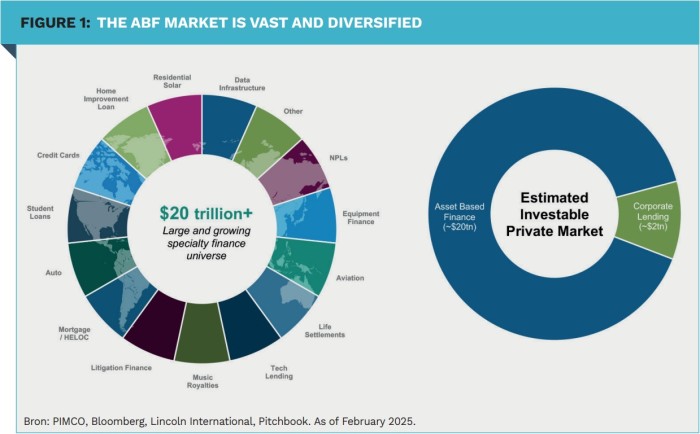
The ABF market is broad, established and growing. The ABF market in the US is about four times the size of the US and European leveraged finance and private corporate direct lending markets. The figure includes total outstanding assetbacked credit and comprises both public securities (held by banks, originators, lenders) and private loan pools (held by investors like asset managers).
Of the $ 20 trillion, approximately $ 12-$ 13 trillion are in residential mortgages, $ 3-$ 4 trillion in consumer credit (student loans, credit cards, auto loans), and $ 3-$ 4 trillion in other asset-backed categories (equipment leasing, aviation finance, et cetera). We estimate that about $ 6 trillion of the total ABF market is investable by private market participants, like the proportion of corporate direct lending in relation to leveraged finance markets (direct lending, high yield, bank loans).
While banks remain active players, regulatory changes have contributed a steady migration of financing activity into a newer ecosystem of non-bank lenders and specialty finance platforms operating in the private credit markets. We believe this is a persistent long-term change that may likely fuel opportunities for private lenders for decades to come.
Myth 3: Asset-based finance is riskier than corporate direct lending
Many ABF investments are high-quality bank balance sheet assets that are now migrating into the hands of private lenders. Not because banks no longer want to hold this credit, but because they simply cannot for regulatory and accounting reasons. While ABL and corporate direct lending differ in structure, neither is categorically riskier. Rather, each presents distinct risks and opportunities.
While ABL and corporate direct lending differ in structure, neither is categorically riskier. Rather, each presents distinct risks and opportunities.
The hard asset-backed nature of ABF markets tends to lead to lower credit spreads versus private corporate markets that fund highly levered corporate balance sheets. In fact, we believe ABF and corporate direct lending can serve as complementary strategies, offering differentiated risk and return profiles that may enhance portfolio diversification across three key dimensions:
1) Borrower type
ABL generally involves exposure to a broad range of borrower types, including consumers, homeowners, and lessees of specialized assets such as aircraft. These borrower bases are distinct from traditional corporate entities and may offer access to diversified, high-quality asset-backed exposures.
2) Cash flow profile
Unlike many corporate direct lending investments, ABF generally involves exposure to a broad range of borrower types, including consumers, both principal and interest. This selfliquidating profile can support ongoing de-risking as principal is repaid over time.
3) Collateral structure
ABF often has hard collateral pledged to the credit agreement to offer lenders additional potential structural protections. Collateral types can range anywhere from single-family homes to aircraft to financial guarantees.
Based on historical data and current valuations, we believe that private ABF portfolios can generate higher returns than corporate direct lending funds. We also estimate that ABF has lower economic volatility and is less procyclical than leveraged direct lending or equity markets.
The potential diversification benefits within the asset class, as compared to other assets, make ABF a valuable addition, not only for private market portfolios, but also for multi-asset portfolios. Strategically incorporating ABF allows investors to thoughtfully increase their private credit allocations while potentially enhancing risk-adjusted returns at the total portfolio level.
1 Size of ABF private market is PIMCO’s estimates. We estimate that approx. 25% of the $20T ABF opportunity set will be addressable by private capital.
|
SUMMARY ABF is straightforward lending backed by hard assets, long established in public markets, and now shifting from banks to private lenders due to post-GFC regulation. The ABF market is vast (≈ $ 20 trillion in the US) and highly diversified, with around $ 6 trillion investable for private markets. ABF is not inherently riskier than corporate direct lending. Hard collateral, selfliquidating cash flows and broad borrower bases offer distinct, often more stable risk–return profiles. |
|
Disclaimer For professional investor use only Per the information available to us you fulfill the requirements to be classified as professional clients as defined in the MiFiD II Directive 2014/65/EU Annex II Handbook. Please inform us if otherwise. The services and products described in this communication are only available to professional clients as defined in the MiFiD II Directive 2014/65/EU Annex II Handbook and its implementation of local rules and as defined in the Financial Conduct Authority’s Handbook. This communication is not a public offer and individual investors should not rely on this document. Opinion and estimates offered constitute our judgment and are subject to change without notice, as are statements of financial market trends, which are based on current market conditions. We believe the information provided here is reliable, but do not warrant its accuracy or completeness. PIMCO Europe GmbH (Company No. 192083, Seidlstr. 24-24a, 80335 Munich, Germany). ©2025, PIMCO. All rights reserved. CMR2025-2810-4944201 |
Bijlagen
Deel dit bericht
Gerelateerde berichten
-
 Lees meer over "PIMCO: From direct lending to asset-based finance"
PIMCO: From direct lending to asset-based finance
-
 Lees meer over "Frans Verhaar: Achter de letters ‘ABF’ gaat een hele wereld schuil"
Frans Verhaar: Achter de letters ‘ABF’ gaat een hele wereld schuil
-
 Lees meer over "Aegon AM: Resilience holding firm as markets test the outlook for European ABS"
Aegon AM: Resilience holding firm as markets test the outlook for European ABS
-
 Lees meer over "Loomis Sayles: Europese ABS weerbaar bij inflatie en marktschokken"
Loomis Sayles: Europese ABS weerbaar bij inflatie en marktschokken
-
 Lees meer over "PIMCO: ABF, quantifying diversification benefits and return potential"
PIMCO: ABF, quantifying diversification benefits and return potential
-
 Lees meer over "Aegon AM: European ABS update"
Aegon AM: European ABS update
-
 Lees meer over "PIMCO: Quantifying diversification benefits and return potential with ABF"
PIMCO: Quantifying diversification benefits and return potential with ABF
-
 Lees meer over "PGIM: Europe at critical juncture for economic growth"
PGIM: Europe at critical juncture for economic growth