
HSBC AM: Accessing the infrastructure debt investment opportunity

Infrastructure debt investing has historically offered investors the potential to benefit from attractive riskadjusted returns. The sector’s long-term growth is supported by several global trends, which are resulting in steadily increasing demand for debt financing.
By Dimitrios Papatheodorou, Head of High Yield Investment - Infrastructure Debt, HSBC Asset Management
According to the World Economic Forum, the total annual capital needed to deliver on cleantech1 and energy transition infrastructure by 2030 amounts to $ 5 trillion2. The rapidly changing energy landscape in the developed world is gradually mirrored in emerging economies and is causing a shift in the operation of power grids.
Demand for electrical power is rising to keep pace with economic development, alongside energy efficiency regulations. Equally, an increasing reliance on renewable power drives both the redesign of power transmission networks and additional investment in energy storage that addresses the intermittency of power generation in a grid that becomes less reliant on fossil fuels.
Digital infrastructure has been a major source of demand for capital in the 21st century. The pace of growth has accelerated with the growing footprint of artificial intelligence in our daily lives, leading to recent estimates for $ 1.7 trillion demand for investment capital until 20303.
Data centres are driving much of the demand for investment in the sector. A typical hyperscale data centre has a size of 50-100MW, and often higher. With the cost to build 1MW of capacity at circa $ 10+ million4, the scale of energy demand is clear.
The large capital requirements combined with the scaling back of traditional lenders from long-duration lending has fuelled the development of new ways to access infrastructure debt investments.
Opportunities can also be found in data connectivity. Dark fibre on trunk routes often comes with revenue models underpinned by long-term contracts with high-quality counterparties. While typically less capital intensive than data centres, it can provide an alternative route to digital infrastructure exposure, that can offer attractive and sustainable investment yields.
Energy transition and digital infrastructure, however, are just the tip of the infrastructure opportunity iceberg. The infrastructure sector is diverse, underpinning every aspect of the economy, and naturally shaped by global economic, demographic and geopolitical trends.
The changing environment following the COVID pandemic fuelled a process of de-globalisation and re-onshoring of economic activities as governments redesigned supply chains to meet changing priorities around production processes and supply security of critical resources, particularly in the developed world.
This trend is generating demand for investment in logistics facilities and transportation infrastructure above the significant5 capital required to maintain, upgrade, and expand current ageing infrastructure. According to McKinsey, an estimated $ 106 trillion in investment will be required through 2040 to meet the need for new and updated infrastructure.6
In many projects, debt financing represents the majority of funding in a typical infrastructure project. The large capital requirements of the energy transition, and AI and digitalisation, combined with the scaling back of traditional lenders from long-duration lending has fuelled the development of new ways to access infrastructure debt investments.
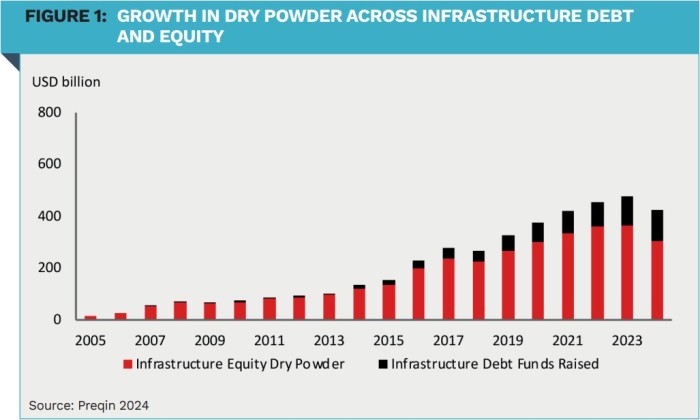
Historically, however, investor appetite has been focused on infrastructure equity. As Figure 1 shows, despite significant growth, dry powder in infrastructure debt has not kept pace with infrastructure equity.
As equity capital is more readily available than debt financing, this can result in more robust and lender-friendly financing structures, with covenants and features that support a borrower’s credit profile, while offering the potential for attractive yields.
Accessing the opportunity
Infrastructure debt investing is often associated with long-term, fixed-rate debt investments, with an investment-grade rating. While this part of the market is well established and offers potential benefits for institutional investors, such as insurance firms seeking to deliver asset-liability matching to their balance sheet, the sector has grown to offer several differentiated strategies that cater to different investor priorities in terms of yield, risk, and sector exposure. These can include strategies which target higher returns by appealing to certain investors’ appetite for higher risk, focusing on second-lien7 and holdco debt8 investments.
Infrastructure debt offers a variety of choice in both returns and duration, as well as exposure across different credit profiles and origination approaches.
Some managers adopt a different approach to delivering high yields, by adopting a direct origination and structuring approach, which keeps most of the economics in a deal with the end investor. They may also focus on smaller transactions, thereby offering the potential for an illiquidity premium. Others may adopt a more thematic approach, by offering investors access to trends including digital infrastructure and energy transition.
Infrastructure debt offers a variety of choice in both returns and duration as well as exposure across different credit profiles and origination approaches. Effective participation depends on aligning investment objectives and risk tolerance with the appropriate manager and strategy.
Across strategies and sector themes, disciplined credit underwriting remains central to infrastructure debt investing. Whether targeting investment-grade or higher-yielding opportunities, managers should apply consistent credit analysis, focusing on sustainable cash flows and structures designed to mitigate assetspecific risks.
1 Cleantech (short for clean technology) refers to products, services, and processes designed to enhance resource efficiency, lower costs, and reduce greenhouse gas emissions
2 ‘Accelerating the Energy Transition: Unpacking the Business and Economic Cases’, WEF (2025)
3 Omdia Cloud and Data Center Market Snapshot December 2025
4 ‘Data Center Buildout Cost: Complete Pricing Guide’, Aptly Technology (2026)
5 The American Society of Civil Engineers (March 2025), estimated a need for USD 9.1 trillion for ageing infrastructure by 2033 in the US alone
6 McKinsey & Company, The Infrastructure Moment (Sep 2025)
7 Second-lien debt is a type of secured loan that is repaid only after all first-lien (senior) loans are fully satisfied in the event of a borrower’s bankruptcy or liquidation. Because this subordinated position increases the lender’s risk of not recovering their capital, second-lien debt typically carries higher interest rates than senior debt
8 HoldCo (Holding Company) debt is a loan taken out by a parent company that sits above operating subsidiaries (OpCos). The parent company does not directly generate revenue from operations. Instead, it relies on dividends and interest from the operating companies beneath it to service the debt
|
SUMMARY Energy transition, digitalisation and geopolitical shifts are driving unprecedented demand for infrastructure investment worldwide. Growing electricity demand, renewable energy deployment and AI-related data centre expansion are creating significant financing needs. Infrastructure debt is benefiting from a shortage of long-term lending capital and can offer attractive yields and lender-friendly structures. Successful investing depends on manager selection, disciplined underwriting and alignment with risk and return objectives. |
|
Disclaimer This publication is a non-contractual document and a marketing communication. It is intended for professional clients as defined by MIFID only and should not be distributed to or relied upon by non-professional clients. The information contained in this publication is not intended as investment advice or recommendation. The commentary and analysis presented in this document reflect the opinion of HSBC Asset Management on the markets, according to the information available to date. They do not constitute any kind of commitment from HSBC Asset Management. HSBC Global Asset Management (France) - 421 345 489 RCS Nanterre. Non contractual document, updated on: May 2026 Copyright: All rights reserved © HSBC Global Asset Management (France), 2026. |
Read the article in the digital magazine